
Spotting scopes are also used for hunting. This applies regardless of whether hunting takes place on flat land or in the mountains. Which spotting scope is particularly suitable for hunting naturally depends on the application. No one wants to carry a particularly heavy lens over long distances. Large lenses prove unsuitable in cramped raised hides. However, one thing can be said across the board. When hunting, spotting scopes save hunters a lot of legwork. They are therefore a useful companion.
These benefits bring spotting scopes for hunting
- Spotting scopes make it possible to identify game over long distances
- Walking distances become obsolete
- The observed game is not or less disturbed
- High-quality spotting scopes (e.g. from Swarovski) allow a clear image even in low light (twilight).
Test winners and proven models
When choosing a spotting scope, many hunters base their decision on the latest test winners from trade magazines or online comparisons. These tests take into account criteria such as image sharpness, contrast, robustness, usability and performance in low light conditions.
The most frequently mentioned test winners regularly include models from
Thanks to their exceptional lens quality and light intensity, these premium manufacturers are particularly impressive when hunting at dusk. For hunters who want to rely on the quality of established manufacturers, such test reports can be a helpful basis for making a decision. You can find some of these premium devices here:
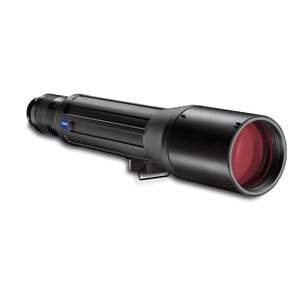
ZEISS Spotting scope Dialyt 18-45x65mm straight eyepiece
Price : 1.324,98 £ (Optics-Pro)
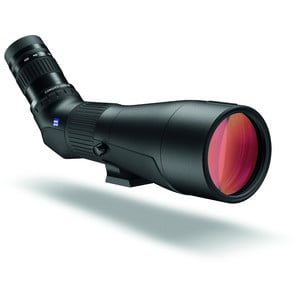
ZEISS Spotting scope Conquest Gavia 85 + 30-60x
Price : 1.753,65 £ (Optics-Pro)
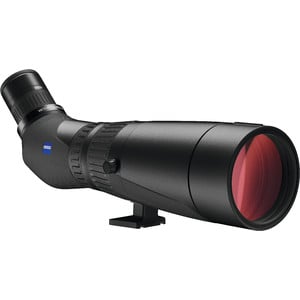
ZEISS Spotting scope Victory Harpia 22-65x85 Set
Price : 3.624,21 £ (Optics-Pro)
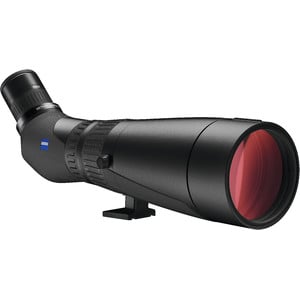
ZEISS Spotting scope Victory Harpia 23-70x95 Set
Price : 4.013,91 £ (Optics-Pro)
Practical tests: What really matters
In everyday hunting, it quickly becomes apparent that it is not only the technical specifications of a spotting scope that are decisive, but above all its practical suitability. A good spotting scope should be quick and intuitive to use, especially when every second counts when targeting game. Focusing also plays an important role: it must be smooth, but still offer enough resistance so that the focus is not accidentally adjusted.
In practice, weight also plays a role. Hardly any hunter wants to carry heavy equipment weighing more than 2 kg. More compact devices, on the other hand, have smaller lens sizes and are therefore usually less suitable for use at dusk. A compromise is necessary here: if you want to reduce weight, you have to make concessions when it comes to use in low light conditions.
A spotting scope in the forest?
No. A spotting scope is nonsense for hunting in the forest. In dense vegetation, it is difficult to target game over long distances anyway. Of course, it would be useful to have long aisles in view with a spotting scope. However, the use of the device would be reduced to very few and very specific situations.
The situation is different in open vegetation, semi-open areas and mountainous regions. Here, spotting game with a spotting scope can be helpful both from a raised hide and from the ground.
Practical tip:If you have good binoculars for hunting, you can often do without a spotting scope.
Affordable spotting scopes: are entry-level models any good?
Not every hunter wants to invest several thousand pounds straight away. There are affordable spotting scopes available, for example from Kowa, Vortex or Celestron, which deliver solid results in the mid-price range. These models are perfectly suitable for hunting, especially in good daylight conditions. However, they quickly reach their limits at dusk.
Those who tend to observe during the day or rarely use a spotting scope will be well served by a cheaper model. For hunters with high demands or regular use, on the other hand, investing in a high-end device is worthwhile in the long term.
Practical tip: If you are still unsure, you should try out a cheap spotting scope first and then invest in a high-end product later.
Tripod: an often underestimated factor
A spotting scope only reaches its full potential when used in combination with a suitable tripod. Even the slightest movements are visible, especially at high magnifications, so a stable base is essential. A spotting scope with a magnification of 20x or more cannot be used handheld. A tripod as additional equipment is essential for using a spotting scope.
For mobile hunting use, lightweight carbon tripods or compact travel tripods are suitable, as they are lightweight but still offer sufficient stability. In a raised hide, however, a slightly more robust model is preferable, as transport and weight are less of an issue here. A ball head or fluid head also makes it easier to track game smoothly.
Extendable spotting scope
For the mobile hunter, pull-out scopes are a suitable companion. Manufacturers such as Optolyth or Swarovski offer various models that the hunter can always carry with him.
With pull-out scopes, the most important thing to look for is workmanship. One of the disadvantages of pull-out spotting scopes is that it is hard to prevent dirt and moisture from entering the device over the years. Cheap products are usually sooner dirty and faster broken than higher-priced devices.

Spotting scopes for the high seat
Many hunters prefer spotting scopes on a raised hide, where the angled view is possible. This view allows targeting of game from a narrow space without further limiting the already mostly lacking comfort in the high stand.
However, many hunters find a spotting scope on the high seat too bulky and clunky. Transporting it up the ladder is also complicated. As an alternative, many hunters therefore decide to mount a spotting scope on their weapon. In the following video, the spotting scope from the manufacturer “Swarovski BTX” is discussed from the perspective of a hunter: